

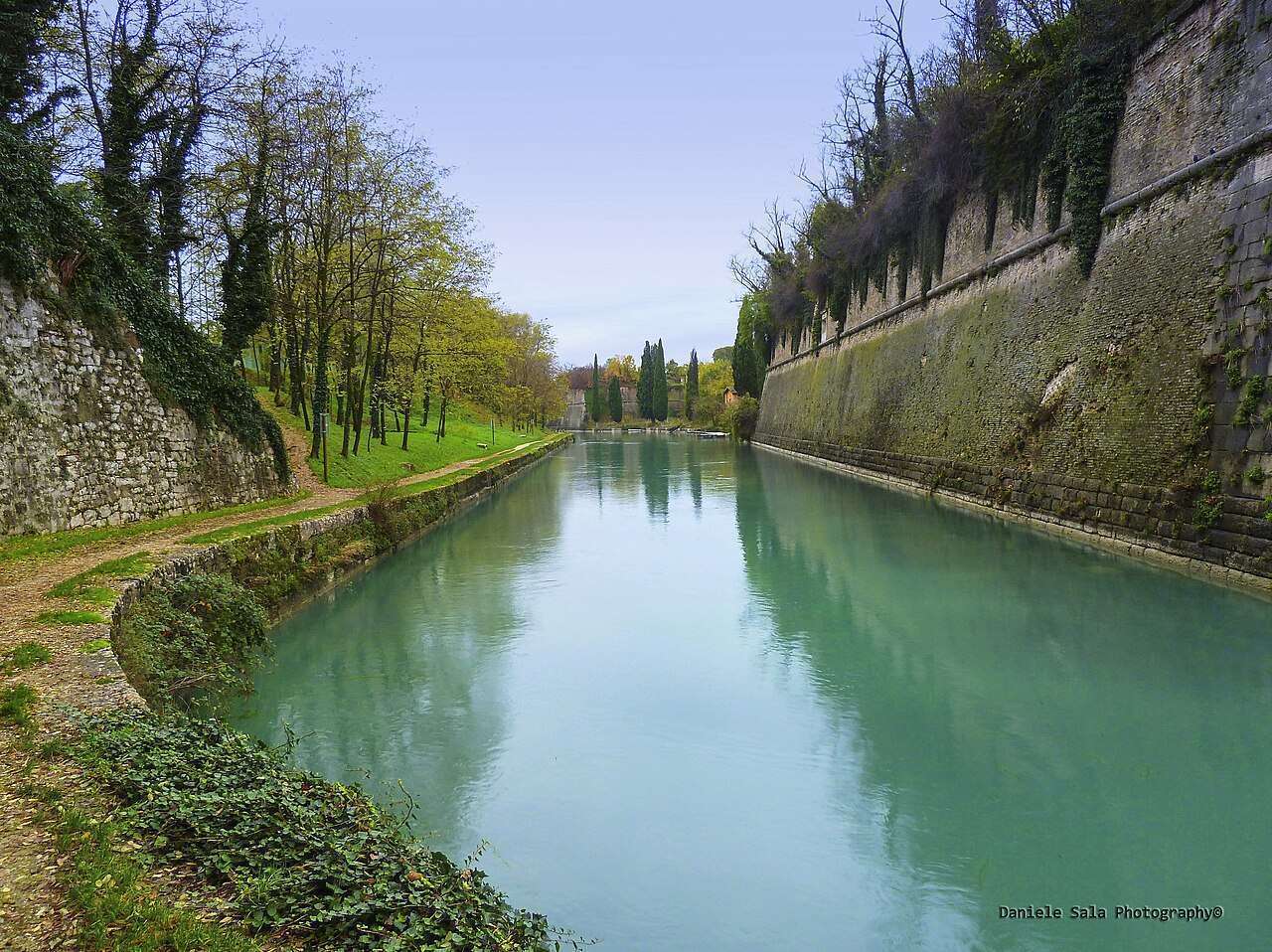
UNESCO Walls of Peschiera del Garda
Peschiera del Garda
UNESCO World Heritage since 2017: the Venetian walls of Peschiera, a pentagonal fortress between the Mincio and the lake — Napoleon's key to Italy.
A City on Water
Peschiera del Garda is a city that seems to float: its historic center rises on an artificial island, completely surrounded by the waters of the Mincio river and the lake, protected by a bastion wall that in 2017 was inscribed on the UNESCO World Heritage List as part of the serial site “Venetian Works of Defense between the 16th and 17th centuries”.
A Layered History
The fortress of Peschiera has a stratified history. The Romans built a castrum here to guard the point where the Mincio exits Lake Garda — a mandatory passage for anyone wishing to control the waterway between the lake and the Po river. In the Middle Ages the fortress passed from the Scaligeri to the Visconti, but it was the Republic of Venice that gave Peschiera the form it still preserves today.
Starting from 1549, the Serenissima’s finest military engineers — including Guidobaldo della Rovere and Michele Sanmicheli — designed a fortress with a pentagonal floor plan, featuring five lance-pointed bastions capable of resisting the new gunpowder cannons. Work continued for over a century, creating a cutting-edge defensive system that integrated walls, ramparts, moats and navigable canals. Napoleon called it “the key to Italy” for its position at the crossroads between Lombardy, Veneto and Trentino. Under the Habsburgs, Peschiera became one of the vertices of the Quadrilateral — together with Verona, Mantua and Legnago — the defensive system that for half a century blocked every Italian advance from the south.
Visiting the Walls Today
Today the walls can be walked along a ring of approximately 2 km, which offers constantly different perspectives: the lake to the north, the Mincio to the east and west, the bastions with their rigorous geometries, the monumental gates — Porta Verona and Porta Brescia — and the casemate galleries that can be explored in some sections. The route is flat and accessible.
Visiting the walls is free and open at any time. For a deeper understanding, guided tours organized by the Pro Loco on weekends are recommended. The historic center, accessible through the gates in the walls, offers restaurants, bars and shops in a compact, pedestrian atmosphere.


