It’s raining, and the day was meant to be about the lake. Before you give up and head back to the hotel: rain on Garda has one useful habit — it tends to come in bands rather than last all day. Summer storms arrive in the late afternoon and blow through in a couple of hours; in spring and autumn it rains more often in the morning, with clear spells later.
That changes the strategy: you don’t need to replace a whole day, you need to fill a few hours well. And unlike many lakeside destinations, Garda has museums, thermal baths and art cities within half an hour’s drive. Here’s what genuinely works.
The thermal baths: the one thing rain improves
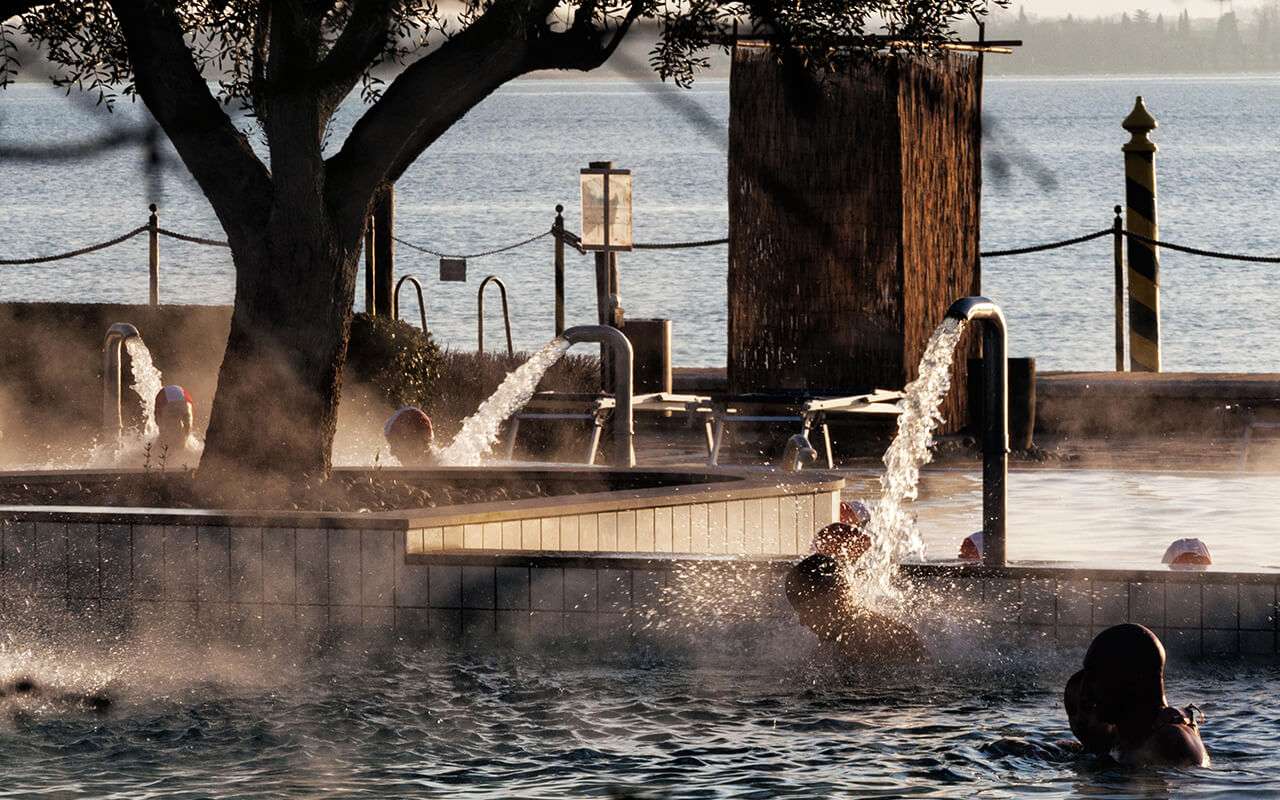
It’s the obvious answer and also the best one. Sitting in hot water outdoors while it rains is a different, and honestly better, experience than doing it in the sun.
Aquaria in Sirmione is the easiest option on the southern lake: the spa is in the old town, you can walk there, and the outdoor pools face the water. The Terme di Sirmione draw on sulphurous salt-bromine-iodine water that rises at 69°C from the lakebed.
Parco Termale Villa dei Cedri, at Colà di Lazise, is the more spectacular version: two natural thermal lakes inside a thirteen-hectare historic park, the main one around 33-34°C. It’s open all year, and in winter the heated pavilions and the winter-garden greenhouse come into play, so it works in December too. It stays open late — in the rain, a floodlit night bathe is worth the trip on its own.
Full picture, prices and differences between the spas in our guide to Lake Garda’s thermal baths.
The Vittoriale, the right museum for a ruined day
Il Vittoriale degli Italiani in Gardone Riviera is Gabriele d’Annunzio’s house-museum, and it’s where rain matters least: the tour of the Prioria interiors takes about an hour and is entirely indoors, through dark, overloaded rooms that almost feel wasted on a sunny day. Add the Auditorium with its aircraft hanging from the ceiling and the D’Annunzio Eroe museum.
The gardens and the ship Puglia are outdoors, so in heavy rain concentrate on the house. One practical upside: in bad weather you’ll get a slot without queueing, which is impossible in August.
Museums worth visiting even in sunshine
MAG in Riva del Garda. The Alto Garda Museum sits inside the Rocca, right on the water: picture gallery, archaeology and the history of the lake. The setting alone justifies the ticket.
MuSa in Salò. The town museum covers Salò’s twentieth century, the Italian Social Republic included. It’s small and takes an hour — ideal for a clear spell that never comes.
Villa Romana and Rambotti in Desenzano. The Roman Villa holds some of northern Italy’s finest late-antique mosaics, under cover. A few steps away, the Rambotti Museum displays the oldest plough in Europe, found in the lake’s pile dwellings.
The wine and olive oil museums in Bardolino. The Wine Museum and the Olive Oil Museum are free, take half an hour each and end naturally in a tasting. In the rain they’re among the very few things on the lake that are both free and indoors.
Parco Natura Viva, from inside your car
Counter-intuitive but true: Parco Natura Viva at Bussolengo stays open in the rain, and the Safari route — lions, giraffes, rhinos, about forty minutes — is done entirely from your own car. Only the walking route and the animal enclosures are exposed, and a raincoat handles those.
If you’re travelling with children and the weather has wrecked a beach day, this is probably the strongest fallback on the southern lake. Other family options are gathered in our guide to Lake Garda with kids.
Escaping to a city
Garda has four art cities within an hour, and in the rain a city works far better than a lakefront promenade.
Verona (30-45 minutes from the southern lake) is the natural choice: Juliet’s House, the museums around Piazza delle Erbe and the arcaded streets of the centre. Brescia is the most underrated: the Santa Giulia Museum and the Roman archaeological park are UNESCO-listed and practically empty in bad weather. Trento, to the north, has Renzo Piano’s MUSE — the best museum in the region if you have children — and the Buonconsiglio Castle. Mantua is the furthest but the finest in the rain: Palazzo Te and the Ducal Palace are hours of interiors.
Cellars, oil mills and long lunches
A wet day is the right moment for the thing you always postpone in summer: a proper tasting. The wineries of Bardolino, Valpolicella and Valtenesi run guided visits under cover, and the oil mills on the Brescia shore do the same with DOP olive oil.
Book the same morning: these are small operations and they fill up when it rains. Where to start in our guides to Garda wines and the lake’s food and wine.
What isn’t worth doing
Worth saying, because these are the common mistakes:
- The Monte Baldo cable car. With low cloud you pay full price to rise into fog. If the summit is covered, postpone.
- The Grotte di Catullo. Despite the name, it’s a completely open-air archaeological site on an exposed headland.
- Scenic boat trips. They keep sailing, but the outer decks close and the windows show you very little.
- Old towns “to wander”. Malcesine, Limone and Sirmione are at their best on foot and outdoors: save them for a clear spell.
Three practical points
Watch the radar, not the forecast. Weather on Garda changes from shore to shore: it can rain in Riva while Sirmione is sunny. A short-term precipitation radar is far more useful than a three-day forecast. Our guide to the weather and the best time to visit explains how the lake’s winds and rainfall work.
Drive, but check first. When it rains, car parks near the town centres fill immediately. Check the restricted-traffic zones in our ZTL guide and the spaces in our parking map.
Book ahead. Spas and museums see sudden spikes on bad-weather days: half the lake has had your idea at the same moment.
And if it rains all week
It happens, especially between October and March. If so, flip the premise of the trip and treat Garda as a cultural and gastronomic destination rather than a beach one: it works surprisingly well, and the full argument is in why the lake is worth visiting off-season. For a general overview, start with what to see on Lake Garda.