

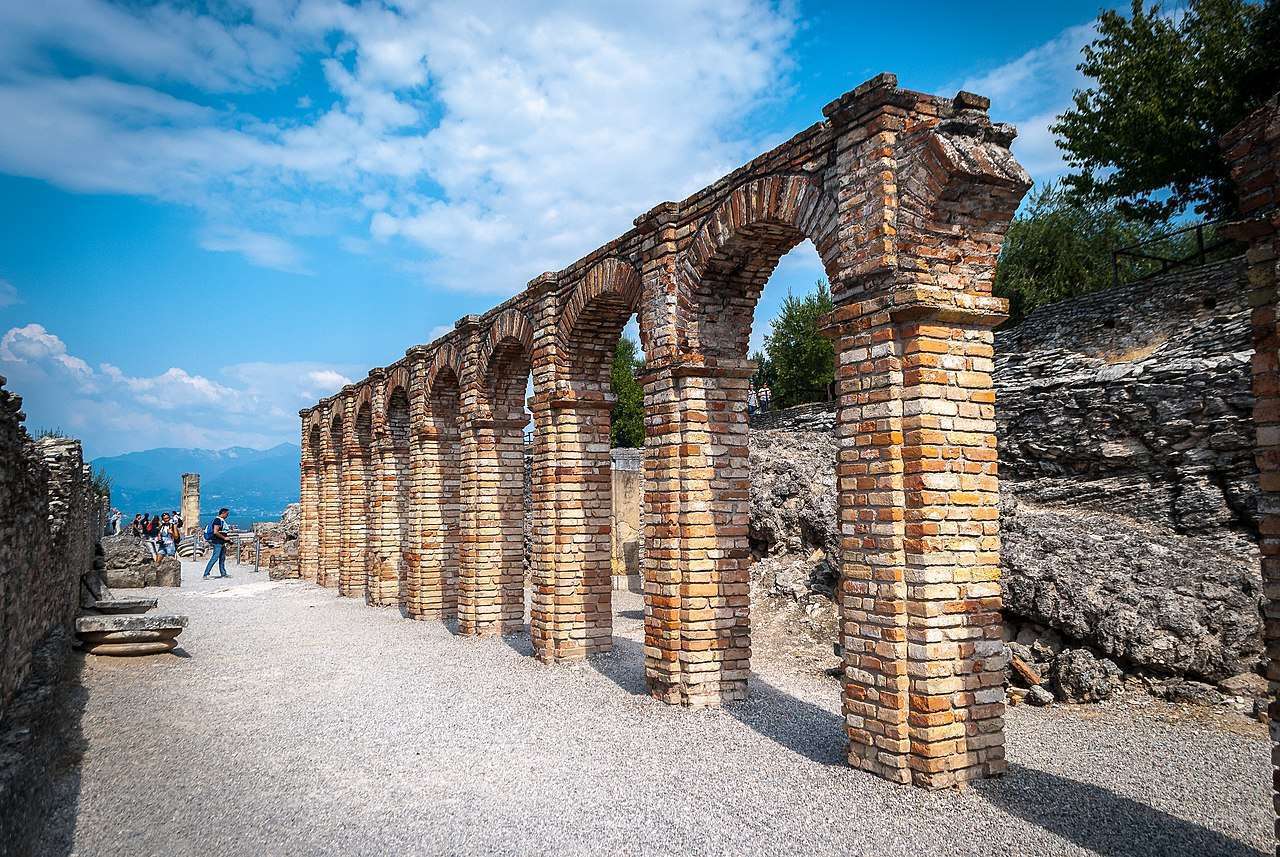
Grottoes of Catullus
Sirmione
Twenty millennia of history on a promontory jutting into the lake: the largest Roman villa in northern Italy and its remarkable museum.
A Roman Villa Among the Olive Trees
At the far tip of the Sirmione peninsula, where olive trees lean toward waters that seem boundless, stand the walls of what was the largest private villa in northern Italy during the Roman era. They are called the Grottoes of Catullus — a name that blends legend and history, because these are not grottos in the geological sense, but monumental remains of a patrician mansion from the 1st century B.C.–1st century A.D., whose collapsed structures covered by vegetation appeared to early visitors as natural cavities.
Architecture and Layout
The villa extends over more than 20,000 square meters, articulated on three levels that exploit the natural slope of the hillside. The rectangular layout — approximately 167 by 105 meters — reveals an ambitious architectural design: long cryptoporticos ran along the north and south sides, providing shelter from the wind and offering covered walkways with views of the lake. At the center, a large garden-terrace dominated the landscape in a full 360 degrees, from the Trentino mountains to the Brescia plain.
History and Attribution
The attribution to the poet Gaius Valerius Catullus (84–54 B.C.), who in his verses celebrated Sirmione as a jewel among peninsulas and islands, remains evocative but is not documented fact. What is certain is that the villa belonged to a family of senatorial rank, capable of financing a building project of this magnitude in a strategically and scenographically privileged location. The on-site Archaeological Museum, housed in a 19th-century building within the park, holds artifacts ranging from prehistory to the Early Middle Ages: fragments of frescoes, floor mosaics, ceramics, coins, and bronze objects found both within the villa and in the surrounding waters. Among the most notable pieces are a white marble male portrait head from the 1st century A.D. and fragments of wall decoration that testify to the richness of the original rooms.
Visiting Information
The visit requires approximately 90 minutes and follows a path that winds through a large olive grove — over 1,500 trees that still produce oil — before reaching the villa’s remains. The most scenic spot is the northern terrace, where the surviving arches stand out against the blue of the lake with mountains in the background: one of the most photographed images of all of Lake Garda. Practical advice: arrive in the early morning hours, when the light is low and tourist groups have not yet arrived. The path is not completely accessible to strollers and wheelchairs due to the uneven terrain. From April to October the site is open continuously; in winter months, it is advisable to check reduced hours. The ticket includes access to both the museum and the archaeological area.


