

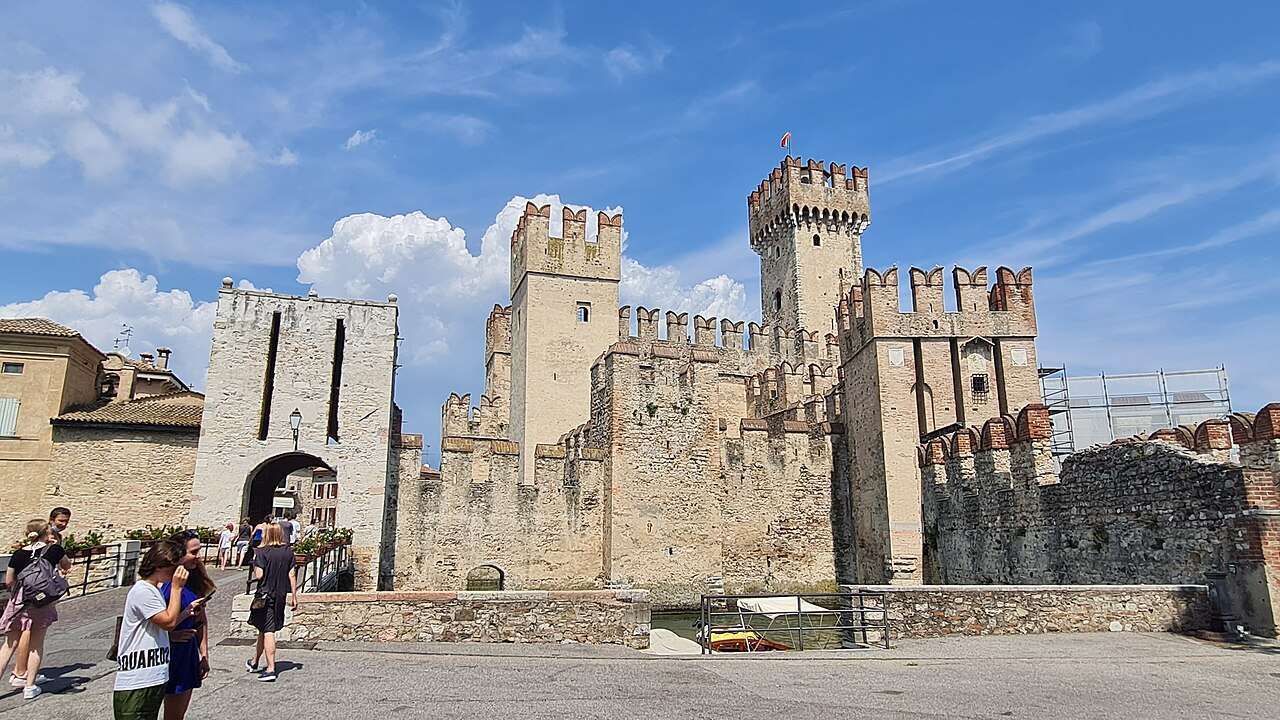
Scaligero Castle of Sirmione
Sirmione
The stone sentinel that has watched over Sirmione for seven centuries, with its 47-metre tower rising straight from the water.
A Scenic Entrance to Medieval History
Few castles in the world can boast such a dramatic entrance: to reach the historic center of Sirmione, you must cross the drawbridge of Scaligero Castle, passing over the lake waters that completely surround the fortress. Built in the second half of the 13th century by order of Mastino I della Scala, lord of Verona, the castle represents one of the best-preserved examples of medieval military architecture in Italy.
Architecture and Views
The crenellated walls rise directly from the water, creating an effect of continuity between stone and lake that has few equals. The keep, standing 47 meters high, dominates the entire southern basin of the lake: from its summit — reached after 146 steps — the view spans from Desenzano to Peschiera, from the Sirmione peninsula to the silhouettes of the Trento mountains.
The fortified shipyard, accessible from the inner courtyard, constitutes an architectural rarity: it is one of very few examples of an intact lakeside military port. Here the Scaligeri fleet found shelter and from here boats departed to control the commercial routes of southern Lake Garda. The walls of the shipyard, lapped by water, form a closed basin where today reflections play among the ancient stones.
Defensive Design and Historical Changes
The defensive system reveals careful planning: three corner towers defend strategic points, while the wall walk runs along the entire perimeter offering ever-changing perspectives of the lake and village. The arrow slits, calibrated for crossbow fire, tell the story of defense techniques from that era.
After the fall of the Scaligeri in 1387, the castle passed to the Visconti of Milan and then to the Republic of Venice, which maintained its military function until the 18th century. The architectural layers — from the 13th-century base to Venetian interventions — are still visible in the walls.
Visiting Information
The visit lasts approximately 45 minutes. The route climbs through the internal rooms, sparse but evocative, to the top of the tower. For those who suffer from vertigo, the final stretches of stairs — narrow and steep — can be challenging, but the view more than rewards the effort. In the summer months, visiting in the evening hours is recommended, when the castle takes on golden tones and queues at the entrance decrease. The ticket is separate from that for the Caves of Catullus.


