

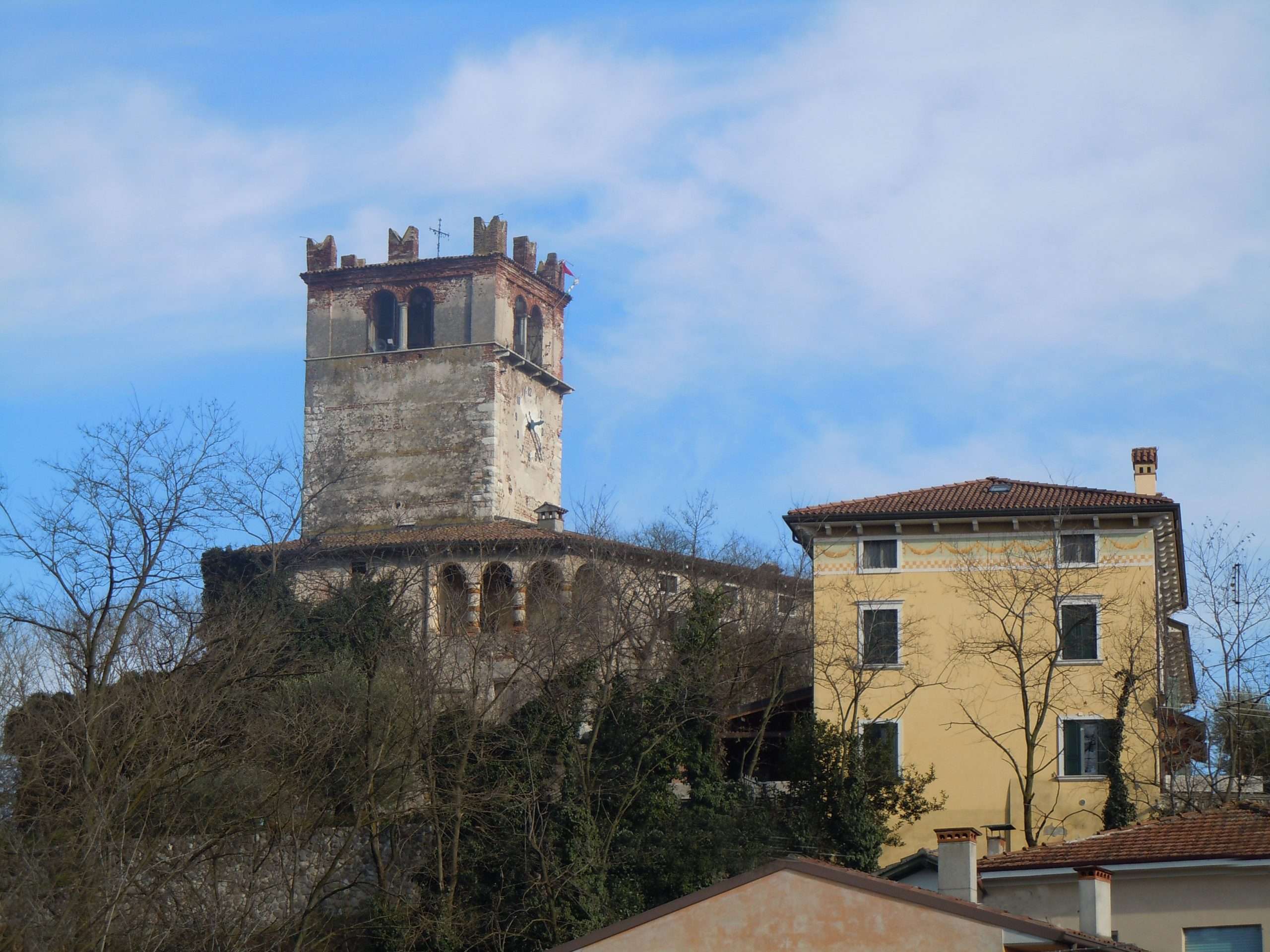
Scaligero Castle of Castelnuovo
Castelnuovo del Garda
The fortress that gave the town its name: the Scaligero castle of Castelnuovo, a link in the defensive chain between the lake and the plain.
Origins and History
Castelnuovo del Garda owes its name to this very castle — the “new” fortress that in the 14th century replaced older defensive structures on a strategic hilltop between the lake and the Veronese plain. The Scaligero Castle of Castelnuovo, built by the Della Scala family in the 1300s, was part of the defensive system that the Scaligeri erected along the eastern shore of Lake Garda to control the territory and commercial routes.
Architecture and Structure
The fortress features an irregular quadrangular plan with corner towers, a central keep, and a crenellated curtain wall that follows the hill’s natural contours. The moat, now largely filled in, once surrounded the entire complex and made a drawbridge necessary for access — a typical feature of Scaligeri military architecture.
Succession and Strategic Importance
After the Scaligeri, the castle passed to the Visconti of Milan (1387), then to the Republic of Venice (1405), which maintained its role as a garrison until the fall of the Serenissima in 1797. Under Venetian rule, the castle was incorporated into the defensive system of the Quadrilateral, serving as a support point between the fortresses of Peschiera and Verona. The various construction phases — Scaligeri, Visconti, and Venetian — are still visible in the masonry and building techniques.
Visiting the Castle Today
The castle stands in the center of town, surrounded by a small park that softens its austere profile. The outer walls are well-preserved and partially accessible from the outside, offering views of the town and the surrounding morainic hills. The interior, which is privately owned, is not regularly open to visitors, but opens on occasion for cultural events, historical reenactments, and heritage days. It can be reached on foot from the center of Castelnuovo del Garda in just a few minutes. While the town is primarily known for its proximity to Gardaland — Italy’s largest amusement park — the castle deserves a visit for those wishing to discover the history behind the town’s name and the medieval profile behind modern attractions.


