Fortified Garda: a history of borders
For centuries, Lake Garda was a borderland. Lombards, Franks, Scaligeri, Visconti, Venetians, Austrians: every ruling power left behind towers, walls, and fortresses. The castles of Lake Garda aren’t just tourist backdrops — they are physical proof of a territory contested for its strategic position between the Po Valley and the Alps. Here is their story, from the most famous to the lesser-known, with up-to-date visitor information.
Sirmione Scaligero Castle: the fortress on the water
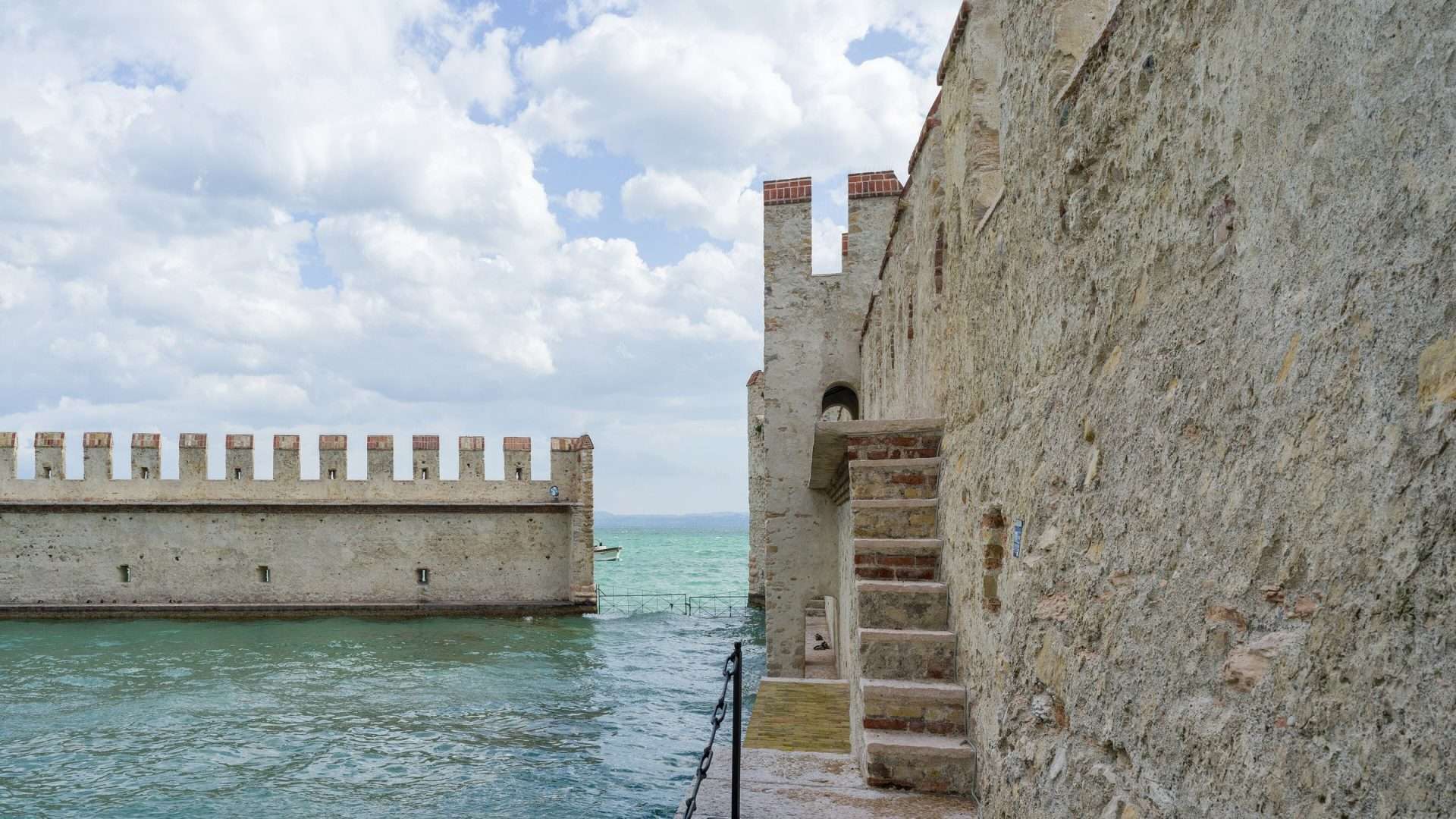
The most photographed castle on Lake Garda stands at the entrance to the Sirmione peninsula, surrounded by water on all four sides. It was built in the 13th century by the Della Scala family as a border fortress and military port. The dock — the internal port enclosed by walls — is the only one of its kind in Italy.
The keep rises 47 meters high. The 146 steps of the spiral staircase lead to a terrace with a 360-degree view over the entire lower lake. The crenellated walls are intact, as is the patrol walkway which can be walked in its entirety.
- Opening hours: Tuesday-Saturday 9:30 AM-7:30 PM, Sunday 9:30 AM-6:00 PM. Closed on Mondays.
- Tickets: full price 8 euros, reduced 2 euros (EU 18-25), free for under 18s.
- Tip: the golden light on the walls at sunset is spectacular. Head in an hour before closing.
Malcesine Scaligero Castle: Goethe’s castle
The castle of Malcesine clings to a rocky outcrop overlooking the lake. Its international fame is thanks to Johann Wolfgang von Goethe, who in 1786, during his Italian Journey, stopped to sketch it and was arrested by the Austrians on suspicion of spying. Today it houses a natural history museum of Lake Garda and Monte Baldo, with a room dedicated specifically to Goethe.
The highest tower offers one of the most beautiful views of the Veronese shore: Malcesine at your feet, the lake to the south, and Monte Baldo behind you. The internal palace, with medieval and Renaissance rooms, is also used for civil weddings.
- Opening hours: every day 9:30 AM-6:30 PM (summer), 10:00 AM-5:00 PM (winter). Check for event closures.
- Tickets: full price 7 euros, reduced 4 euros.
- Fun fact: the drawing Goethe was making when he was arrested is lost — only the description in his diary remains.
Torri del Benaco Scaligero Castle: the castle with the lemon house
The castle of Torri del Benaco is perhaps the least known of the Scaligero castles on Lake Garda, but for that reason, it’s the most authentic. Inside, it houses an ethnographic museum that tells the story of life on the lake: fishing, olive growing, and navigation. But the highlight is the lemon house in the castle courtyard, still functioning, with lemon trees that bear fruit every year — a living remnant of the citrus economy that characterized these shores for centuries.
- Opening hours: from April to October, every day 9:30 AM-12:30 PM and 2:30 PM-6:00 PM.
- Tickets: full price 4 euros, reduced 2 euros.
- Don’t miss: the rock carvings in the prehistoric section of the museum.
Lazise Castle: the first free Commune
The medieval walls of Lazise still embrace the entire historic center. The castle itself, with its towers and fortified enclosure, is visible from the outside but cannot be visited internally (it is private property). However, the perimeter walls, the entrance gates, and the Venetian customs house on the lakefront are freely accessible and tell the story of a village that in 983 obtained the first communal statute in Italy from Emperor Otto II.
- Access: exterior free. Interior private.
- What to see: the three entrance gates to the village, the Venetian customs house, the walled harbor.
- Tip: the Wednesday morning market transforms the lakefront into an event of colors and scents.
Rocca di Lonato: the fortress on the hill
The Rocca di Lonato dominates the southern Garda hinterland from a hill at 190 m. Viscontea and then Venetian, the fortress is massive: thick walls, corner towers, and a keep watching over the plain. Next to the fortress, the Casa del Podestà houses the Ugo Da Como Foundation with a library of 50,000 volumes and an art collection. From here, the view stretches from the lake to the Brescia plain — a strategic point that justifies centuries of conflict.
- Opening hours: Saturdays, Sundays, and holidays 10:00 AM-6:00 PM. Guided tours of the Casa del Podestà.
- Tickets: full price 5 euros (fortress), 10 euros (combined fortress + Casa del Podestà).
Arco Castle: the ruin dominating the valley
The Castle of Arco is a ruin, but a powerful one. Perched on a rocky pinnacle at 273 m, it is reached via a 20-minute climb from the town center. It was the seat of the Counts of Arco from the 12th to the 17th century, then destroyed by French troops in 1703. Towers, walls, and the throne room with medieval frescoes (ladies playing chess and checkers) remain, along with a view that takes in the entire Sarca plain down to the lake.
- Opening hours: every day 10:00 AM-6:00 PM (summer), 10:00 AM-4:00 PM (winter).
- Tickets: full price 5 euros, reduced 3.50 euros.
- Note: the 14th-century frescoes in the tower are among the most interesting in Trentino. They have endured for 700 years.
Rocca di Manerba: the fortified promontory
The Rocca di Manerba is not a castle in the classic sense: it is a natural promontory fortified since the Bronze Age. The remains of the medieval fortress (destroyed by the Republic of Venice in 1574) are at the top, at 216 m. The value lies in the landscape: the view of Isola del Garda, Valtenesi, and the entire lower lake is among the widest on the western shore. The surrounding natural park is a reserve with wild orchids and birds of prey.
- Access: free, all year round.
- Visitor center: open from April to October with exhibitions and guided tours.
- Tip: bring binoculars. Hawks and buzzards are easily spotted.
Forte Naole and the Austro-Hungarian forts
The Forte Naole belongs to a different category: it is a Great War fort, built by Austria-Hungary on Monte Baldo to defend the border with Italy. Reachable via a medium-difficulty hike from Brenzone, the fort is a stone and reinforced concrete building with loopholes, ammunition depots, and artillery positions. The visit is free and the atmosphere is that of a forgotten place, where nature is slowly taking back over.
In the same area, Monte Brione above Riva del Garda preserves other Austro-Hungarian forts (Forte Garda, Batteria di Mezzo), which can be visited along the Monte Brione path.
The Valtenesi castles: the fortified ring
The hinterland of the Brescia shore hides a system of medieval castles that are less known but full of charm. The Valtenesi Castle Ring is an itinerary that touches the fortresses of Moniga, Padenghe, Drugolo, and Soiano, all built between the 10th and 13th centuries as a defense against Hungarian raids.
The Castle of Padenghe, with the church of Sant’Emiliano inside the walls, is perhaps the most evocative. The walled enclosure is intact and the view over the hills planted with vines and olives tells of a landscape that hasn’t changed much since the Middle Ages.
Visiting Garda’s castles: recommended itinerary
With three days you can visit the main castles, combining history and scenery:
- Day 1 — Southern shore: Sirmione (morning), Lazise (afternoon), Rocca di Lonato (late afternoon).
- Day 2 — Eastern shore: Malcesine (morning with cable car), Torri del Benaco (afternoon).
- Day 3 — North and Valtenesi: Arco (morning), Rocca di Manerba and Valtenesi castles (afternoon).
The Scaligero castles are the best preserved and most visited. But don’t underestimate the lesser-known fortresses: it’s often there, away from the crowds, that you can truly feel the history.
Discover Lake Garda destinations and our cultural itineraries to delve deeper into the history of the area.